


Ready made leaders - no2
- Feb 13
- 4 min read


Lots of companies offer ready-made leaders. I use SA's leaders (Scientific Anglers) because I know exactly what I am getting, and all the information I need is readily available.

All companies state the length and the break strength of their leaders, but if the diameters (butt-tippet) of each leader aren’t stated, I will not buy that leader.
I have defined the three parts of the leader. First comes the butt end, which needs to be 70% of the diameter of the floating fly line tip. The middle part then tapers, and the leader ends in the level tippet. The tippet needs to match the hook size to a degree.
Modern commercial leaders have become fantastic. They are offered in various lengths, tippet/butt diameters, suppleness, and break strengths. You can find a leader for all your fishing needs from various companies. I strongly advise beginners to use the commercially available leaders at the outset. Mono has become much stronger over the years, and the quality of the leader material has improved. If anglers can’t find a leader that works for them, they need to fix their casting!
Ready-made leaders mostly come with a pre-tied loop on the butt end. When you use such a ready-made leader, there is only one knot to worry about -- the one for the fly. There are certain types of knots that work well for backing to reel, backing to fly line, fly line to the leader, leader to tippet, and finally tippet to the fly. The knot to learn first is therefore in the terminal connection category.
This site lists 34 terminal knots that you can use. There are undoubtedly many more. To tie the fly onto the leader, I use the classic Clinch knot and sometimes the Uni knot. It does not really matter which one you use if they are tied badly! So, which knots to choose? Actually, it does not matter much which type of knot you choose, just choose one for each job and stick with it.
Ready-made leaders
You can find a plethora of ready-made leaders for various situations. Trout leaders, salmon leaders, and saltwater leaders (for bonefish, permit, and redfish, for instance). The length can be from four feet to 13.5 feet. Various break strengths are on offer too. The important variables are break strength, length, and the diameters of the leader.
The marketing is, of course, there, but these leaders are high-quality copolymer nylon with a relative density of 1.2. The leaders are innate and do not know where they are; the fish don’t care for the marketing. Therefore, you can use them wherever the specs are to your liking.
Leader length
When and why do we choose a short or a long leader? Usually, it has to do with visibility. If the water is cloudy and the day is overcast, we can use shorter, thicker leaders. If the water is gin clear, visibility is good, and clear skies with no wind, we use longer, thinner leaders. The leader length is also dependent on the size and weight of the fly. It is very hard to cast a heavy fly with a long leader. When the weight of the fly increases, you can cast with a conventional rod. There are 30-foot leaders that are used for so-called Euro nymphing with heavy flies - the momentum of the heavy flies pulls out the leader.
Four-foot leader
Good for sinking lines and can be used with lines with a clear end - floating or intermediate. It is easy to cast.
Seven feet six-inch leader
Short, powerful, and ideal for casting big/heavy flies/fly. Just remember to open your loops when delivering the heavy load. On a windy day, this leader can become a great trout leader. This length leader is also easy to cast.
Nine-foot leader
This leader length can be viewed as the standard-length leader. This length is my default and is practical in most situations. Just a tad more difficult to cast than the 7.5’ leader for a beginner.
Eleven-foot leader
This leader length can become useful in situations where the fish enjoy great visibility – clear water, mirror surface, sunny day. If the trout are finicky, an eleven-foot leader places the end of the fly line further from the fish, which can become advantageous. However, those extra 2 feet will become much harder to cast for a beginner.
Thirteen and a half feet leader.
For the savants of fly casting, not to be recommended to beginners.
Sinking lines
When sinking lines are used (sinking, sink tip, or intermediate clear tip lines), you do not need a long leader. Four to five feet leaders are sufficient. For floating lines with a clear end, a short 4-5 foot leader is fine too.
But which one ...............?
Two types of leaders are a novelty (picture below). When going for toothy critters, you often use two feet of wire on your leader. It sometimes becomes difficult to tie on a wire, but now that problem is solved (picture 2). Tarpon does not possess teeth, but the inside of its mouth is abrasive, and leaders can get shorn there. The solution was/is to tie a thick terminal tippet onto the leader called a shock tippet. This type of tarpon leader is now commercially available (picture 6). Below is a sample of available leaders from one manufacturer.


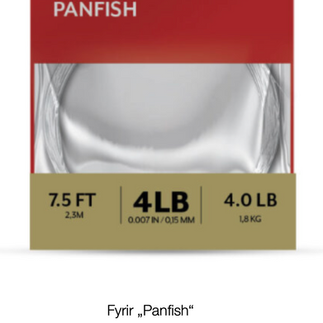


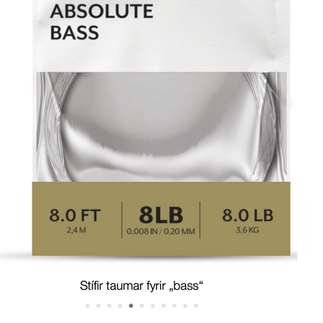





I have tried to explain the fundamental basics of how you choose your leader. When you understand those, you can choose which leader to use in the different scenarios you encounter. Remember that the leader you need to use is dependent on your casting abilities, and to a degree on the weather, too. In bad, windy weather, go shorter. If there is great visibility for the fish, then go longer but never exceed your casting abilities.
Your leader choice in a nutshell
1. The fly line determines the leader’s butt end diameter
2. The leader’s length is dependent on the conditions where you fish (weather - colored water) and also the size and weight of your fly and lastly on your casting abilities.
3. The break strength is determined by the size and type of fish.


Comments