


CASTING SINKING LINES
- 3 days ago
- 5 min read

Until now, I have taken little pleasure in casting sinking fly lines, whether sink-tip lines or full sinking lines. That is hardly surprising. To sink effectively, these lines must carry most of their weight toward the front, which means they often have a tendency to “kick” quite aggressively. As a result, I have always found sinking lines more difficult to cast than floating lines.
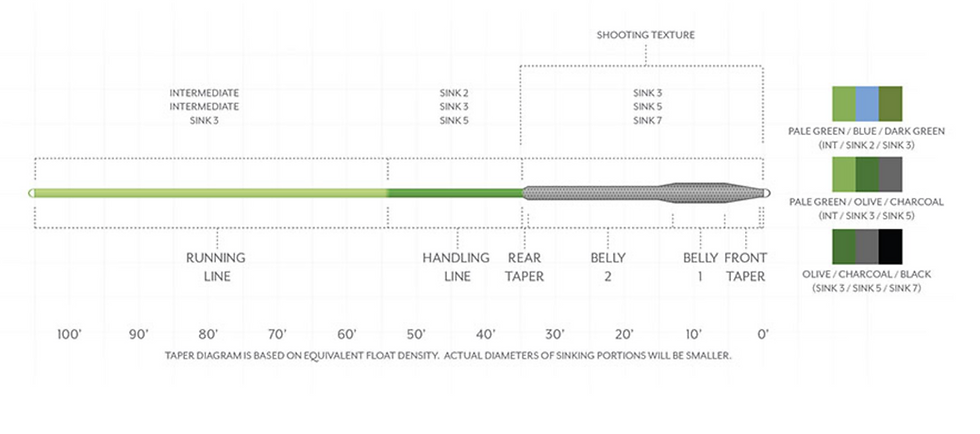
Recently, a new full sinking line design was introduced under the name Sonar Titan 3D Triple Density. The design is that the majority of the running line—about 45 feet—has the lowest density. This is followed by roughly 20 feet of denser running line, while the 35-foot head is the densest section of all. The result is a line that sinks in a nearly straight profile, minimizing slack and making it easier both to detect takes and to set the hook. The manufacturer, Scientific Anglers, also claims that the line casts like a floating line.
My first reaction was simple: “Here we go again—another piece of marketing hype.” If something sounds too good to be true, it usually is.
Still, my curiosity got the better of me. I picked up a weight-forward #6 S line (I/S3/S5 – intermediate, sink 3, sink 5) and put it to the test on the Laxá River in the Mývatn area. There, it performed exceptionally well in large, fast-flowing pools. It sinks effectively, maintains excellent contact with the fly, and makes it easy to react quickly to a take. So the first claim certainly holds up. What surprised me even more was that the second claim turned out to be true as well. This line casts far more like a floating line than any other full sinking line I have used. In my view, Scientific Anglers has come remarkably close to producing the perfect sinking line.
Why are the traditional kicking sinking lines difficult to cast?
Remember they are not designed to be cast easily – they are designed to sink and cast big, heavy flies - to catch fish floating lines can’t reach.
These lines kick because the leader can’t bleed away the surplus energy in the fly line’s end.
So, the real issue is the transition from the line tip to the leader. It is difficult to impossible to match the mass of the leader’s butt to the mass of the line tip. The line tip may be very small but quite heavy due to its density – remember it’s designed to sink. To match the masses, the leader’s butt would have to be considerably thicker than the fly line’s end.
Correctly designed lines will have a mass profile that doesn’t change when going from the floating to the fast-sinking sections of a sink tip line. The floating part is huge, the sinking part is small, but the mass/inch is the same. Badly designed sinking tips lines will, in addition, have the clunky, uneven mass transition.
Two errors
Usually, fly slingers make two errors when they cast and rig sinking lines.
The line. The first error relates to the cast. Understandably, casters try to cast the sinking line as they would cast a floating line, and that does not work very well. Cast a line like that straight back; it will stop and bounce and create slack. Because of the kick, with each cast, control of the line is lost, and it compounds (remedy below). Remember the big and heavy fly usually used in tandem with a sinker is waiting for its opportunity to strike the back of the caster’s skull – ears are a good target too. So, false casting should be minimized and can be downright dangerous.
The leader. The second error relates to the leader. The butt of the leader anglers use is frequently way too thin, so the transfer of energy will not be optimal, creating more bounce. To use a suboptimal leader is an unforced error. Sometimes your casting abilities are evolving, but the effort of tying on a suboptimal leader is the same as tying on an optimal one.
Since the issue with sinking lines is at the transition to the leaders only, there isn't a need for long leaders, at least not to cure casting ills. The leaders need to be long enough to temper the kick somewhat, but no longer. When the line kicks, so does the leader, of course. The part of the leader’s butt forward from the fly line helps to temper that kick; usually, 2-3 ft. of butt is enough. There are diminishing returns going longer than that. Then add a taper and tippet, and a total leader length of 4-6 ft. works well for casting, and the short leader also gets the fly down quicker than a longer leader would do.
How to cast a kicking sinking line
The solution: Forget nice, sharp loops; these lines can’t be controlled casting that way. Open your loop to minimize the kick. Make one back cast and then briefly lay the line down in front of you. Pick that line up and make another back cast, shooting line to get the line’s head out of the tip-top, then shoot the front cast. No false casting is required. Lay down every fore-cast once the head is out of the tip-top and shoot the next fore-cast. This is much safer and easier to do than trying to false cast with a dense head and a big, heavy fly. A Belgian or an oval cast works very well, especially with an on-shoulder wind.
Here is a video of the Belgian cast:
As you retrieve your line and get ready for the next cast, the line is now in the water, not on the water as the floater is. It is not possible to go into a backcast with the line sunken like that. You might even break your rod if you tried. The solution is to make a roll cast or two and get the line to the surface. Once there, we can make our usual pick-up (roll cast pickup). Remember to pinch down the barb for your own sake, if not for the fish’s, just in case.
Line management of a sinker: Fishing in water, the stripped sinking line will sink if not managed. Obviously, the line does not come as easily from the water as a floating line comes off the water. The stripped line can be coiled and held in the stripping hand, or a stripping basket can be used.
Rod: Casting sinking lines isn't about short distance and accuracy; it's all about distance and covering a lot of water. Therefore, soft rods (noodles) aren't appropriate. In the right hands, they can work, of course, but why fight a slow rod when a faster one would work better? Beginners and intermediate casters would be well advised to use fast rods for casting sinkers.


Comments